
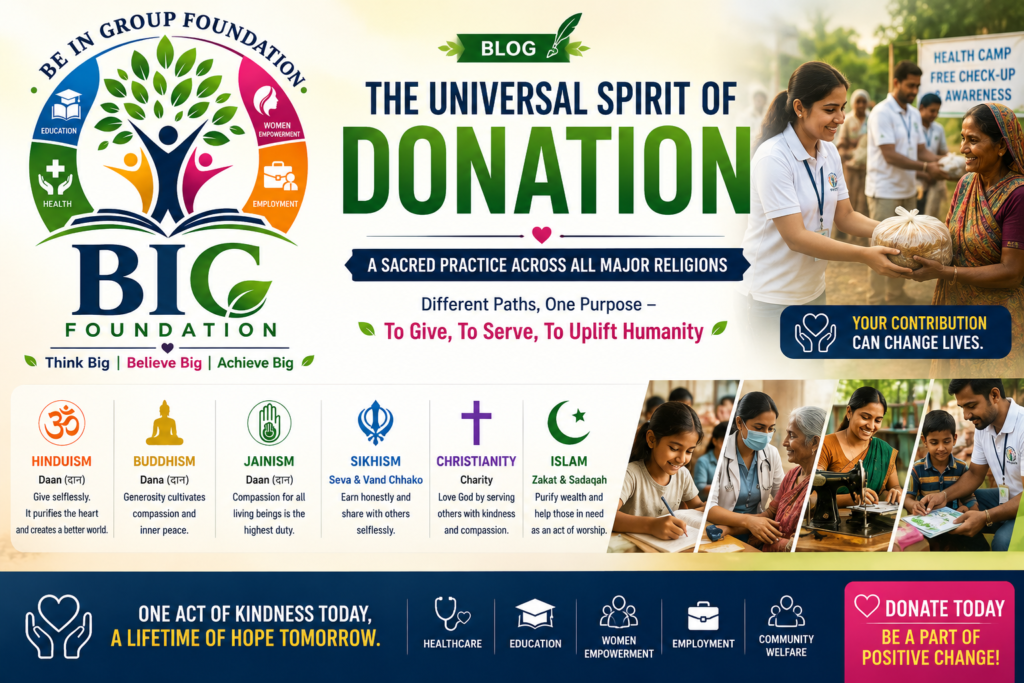
One of the most amazing truths about humanity is that every major religion emphasizes the value of generosity, compassion, and assisting those in need. Whether it’s termed Daan, Dana, Zakat, Tzedakah, Charity, or Seva, the premise remains the same: giving selflessly leads to spiritual growth and societal harmony.
This ageless legacy is continued by organizations such as the Be In Group Foundation, which serves communities via healthcare, education, women’s empowerment, and humanitarian efforts.
1. Hinduism – Daan (दान)
In Hinduism, Daan is considered one of the highest virtues. It is believed that wealth is a blessing from God and should be shared with those in need.
Bhagavad Gita (17.20)
दातव्यमिति यद्दानं दीयतेऽनुपकारिणे।
देशे काले च पात्रे च तद्दानं सात्त्विकं स्मृतम्॥
Translation:
“That charity which is given as a duty, at the proper place and time, to a worthy person, without expecting anything in return, is considered pure (Sattvic) charity.”
Lord Krishna teaches that the highest form of giving is selfless giving.
Mahabharata
The Mahabharata celebrates Daanveer Karna, who gave away his divine armor and earrings, demonstrating that true generosity often requires personal sacrifice.
Another famous teaching states:
दानं भोगो नाशस्तिस्रो गतयो भवन्ति वित्तस्य।
Translation:
“Wealth has only three destinations—charity, enjoyment, or destruction. If it is neither enjoyed nor donated, it is eventually lost.”
2. Buddhism – Dana (दान)
In Buddhism, Dana is the first of the Ten Perfections (Paramitas) and forms the foundation of spiritual practice.
The Buddha taught that generosity reduces attachment, develops compassion, and creates merit (Punya).
Dhammapada (Verse 224)
“Conquer the stingy by generosity.”
Another well-known Buddhist teaching says:
“The gift of Dhamma excels all gifts.”
This means that while material charity is noble, sharing wisdom and compassion is the greatest gift.
Buddhist monks traditionally depend on donations from the community, creating a cycle of generosity and mutual respect.
3. Jainism – Daan (दान)
In Jainism, charity is an essential expression of Ahimsa (Non-violence) and compassion toward all living beings.
The four traditional forms of charity are:
- Anna Daan – Food
- Aushadhi Daan – Medicine
- Abhaya Daan – Protection from fear
- Jnana Daan – Knowledge
Tattvartha Sutra
“Parasparopagraho Jivanam” (परस्परोपग्रहो जीवानाम्)
Translation:
“All living beings are bound together by mutual support and interdependence.”
This teaching reminds us that helping others is part of our shared responsibility.
4. Sikhism – Seva and Vand Chhako
Sikhism places extraordinary importance on selfless service (Seva) and sharing one’s earnings.
Guru Nanak Dev Ji taught three guiding principles:
- Naam Japna – Remember God
- Kirat Karni – Earn honestly
- Vand Chhako – Share with others
The institution of Langar (free community kitchen), started by Guru Nanak and strengthened by later Gurus, serves millions of meals every year without discrimination.
Guru Granth Sahib
“ਘਾਲਿ ਖਾਇ ਕਿਛੁ ਹਥਹੁ ਦੇਇ, ਨਾਨਕ ਰਾਹੁ ਪਛਾਣਹਿ ਸੇਇ।”
Translation:
“Those who earn honestly and share with others have found the true path.”
This principle inspires Sikhs around the world to support education, disaster relief, healthcare, and community welfare.
5. Christianity – Charity
In Christianity, charity is considered one of the greatest expressions of love for God.
Jesus Christ repeatedly encouraged caring for the poor, the sick, widows, and strangers.
Acts 20:35
“It is more blessed to give than to receive.”
2 Corinthians 9:7
“God loves a cheerful giver.”
Matthew 25:40
“Whatever you did for one of the least of these brothers and sisters of mine, you did for me.”
Christian organizations worldwide have established hospitals, schools, orphanages, and humanitarian missions inspired by these teachings.
6. Islam – Zakat and Sadaqah
Islam regards charity as both a spiritual duty and a social responsibility.
There are two primary forms of giving:
- Zakat – Obligatory charity, one of the Five Pillars of Islam.
- Sadaqah – Voluntary charity given out of compassion.
Qur’an (2:261)
“The example of those who spend their wealth in the way of Allah is like a seed that grows seven ears; in every ear are one hundred grains. Allah multiplies for whom He wills.”
Qur’an (57:18)
“Indeed, those men and women who give charity and lend to Allah a good loan—it will be multiplied for them.”
The Prophet Muhammad (peace be upon him) also taught:
“The best of people are those who are most beneficial to others.”
(Reported in al-Mu’jam al-Awsat; widely quoted in Islamic tradition.)
Islam encourages supporting the poor, orphans, widows, travelers, and those facing hardship.
A Common Message Across All Faiths
| Religion | Principle of Giving | Core Message |
|---|---|---|
| Hinduism | Daan | Give without expectation. |
| Buddhism | Dana | Generosity removes attachment and cultivates compassion. |
| Jainism | Daan | Compassion for all living beings. |
| Sikhism | Seva & Vand Chhako | Earn honestly and share with others. |
| Christianity | Charity | Love God by serving humanity. |
| Islam | Zakat & Sadaqah | Purify wealth by helping those in need. |
Why Your Donation Matters Today
Across all religions, one truth remains constant:
- A hungry person needs food.
- A sick person needs treatment.
- A child needs education.
- A woman needs dignity and healthcare.
- An elderly person needs care and compassion.
By donating to initiatives like Be In Group Foundation, you become part of a centuries-old tradition of compassion that transcends religion, culture, and geography.
Whether your contribution supports breast cancer screening, rural healthcare, education, nutrition, or community development, every act of giving creates hope and transforms lives.
The world’s great religions may differ in rituals and traditions, but they are united in one timeless principle: selfless giving is a sacred act. Hinduism teaches Daan, Buddhism encourages Dana, Jainism upholds compassionate charity, Sikhism inspires Seva, Christianity calls us to charity, and Islam establishes Zakat and Sadaqah as pillars of faith.
When we give with kindness and humility, we not only help those in need—we strengthen our communities, uplift humanity, and honor the spiritual wisdom passed down through generations.
“The hands that serve are holier than the lips that pray.” – A widely quoted saying that beautifully captures the universal spirit of selfless service.